Invention of Brush Cutter with Energy-Efficiency
Purpose
The latest regulation made by United States government in responding to the issue of global warming. All the farming machines such as chain saws, trimmers, Engine drills, and so far and so forth with the engine consuming petroleum are now allowed to be used since 2010. In order to survive for this trend in this industry in the future, all the manufacturers are striving to develop “green machine” without any contaminations. The owner of Minwa Green Machinery Technology, Mr. Chen, was applying Chief FleXense to monitor the electricity consumption during his experiment for inventing the electric trimmer. Mr. Chen was trying to simulate several scenarios while the farmers are trimming the weeds. Finally, he was successfully to develop the trimmer with low electricity consumption and make the weeding more efficient.
Experimental System
| Software |
Hardware |
 |
NI cDAQ 9172 |
| NI-9219 |
| Current Clamp |
Method
The trimmer has to be tested in three scenarios one is discharging status, one is trimming status, the other is the charging status.
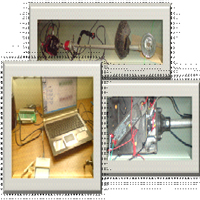
- Discharging:
Firstly, the trimmer has to be charged until the battery is full with current clamp connecting to the positive and negative of the battery. And then the signal from current clamp needs to be transmitted to the voltage module as the analog signal into FleXense analyzing system. Secondly, turn on the power of the trimmer in order to record the consumption pattern in the FleXense for a very long period。 Also, different loading on the trimmer is an important data needed to be noticed during the test of electricity consumption. For example, the consumption of using steel-made knife is different from that of using others knife. Finally, this experiment turns out to be an interest discovery. Actually the consumption of using steel-made knife is twice of using plastic one.
- Trimming:
There is another interesting scenario. The knife of the trimmer is tested in a pail with full water to simulate the scenario that the trimmer is working. At the mean while it is obvious to see the electricity consumption is increasing and being recorded until the battery is out.
- Charging:
The third scenario is to record the discharge status. FleXense was recording the process that the battery on the trimmer was discharge from full battery and then charged it again until it was full. FleXense could diagnose how long it took.
Conlusion
The test has to be measured in the premise that the original structure of the trimmer is always keeping complete, so only the untouchable sensors are allowed to be applied to this experiment. But it is impossible to record the voltage and current as data, if you employee the ordinary current clamp. Although there are some current clamps with the function of program and simple system, end users are not able to integrate other signals from multi-channels simultaneously. Thus, it is flexible to add the numbers of channels and integrate different signals at the same time. Plus, the recording for a long period, such as 24hrs, 1 week, and even 30 days, in the FleXense is ok. So, it is very good for the test of trimmer. Likewise, FleXense is good for other applications as long as they need to record the data for a long period.
