Elevator Security Design
Abstract
This experiment is measured to see the impactions resulting from vibration, sound, and displacement of motor and cage on the elevator and to see if the passengers feel comfortable when it is working up and down. By doing so, the engineers are able to improve the stability of operation and decrease the probability that machinery parts may break down while the operation.
System List
| Software |
Hardware |
 |
NI 9172 |
| NI 9233 |
| NI 9215 |
| IEPE Accelerometer*8 |
| Strain Type Accelerometer*3 |
| Sound Meter |
| Pulse Hammer |
Description
There are two tests in this experiment. One is motionless status, another is motion status.
- Motionless Test
Firstly, the IPPE vibration sensor with the magnetic stand is installed in the motor room. Totally 8 sensors are around the motor. The positions of each sensor are defined by the end user himself. There are four sensors out of eight are located at the four corners of the motor via the cushion with the function of absorb the shock. On the other hand, the rests of sensors are located in front of the cushion. Furthermore, end user beats the point with 3G power beside the sensor. Each beat has to be recorded in FleXense. After beating 8 times, the 8 data needed to be brought back to FleXense in order to analyze them. Compared with other signals of 7 sensors, the signal of first sensor can be diagnosed with the differences. The rests of seven were also done likewise.
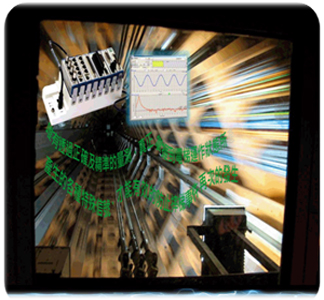
- Motion Test:
The accelerometer with strain gauge was settled down in the car by 3 axes, XYZ. The end user noted down the displacement and the vibrations from 8 IPPE accelerometers simultaneously while the elevator was going up. Moreover, end user stopped the elevator and then recorded the displacement and the vibrations from 8 IPPE accelerometers while the elevator was going down until it stopped. Finally, end user could see the relationship among the accelerometers during the vibrations.
