PCB Strain Measurement
Purpose
Strain is a required measurement for a wide range of applications from structural tests to bridge and dam health monitoring to PCB stress distortion measurement. While strain is a fundamental measurement, many people are still not familiar with various aspects of it, such as performing strain tests and high temperature distortion gauging on PCB motherboards.
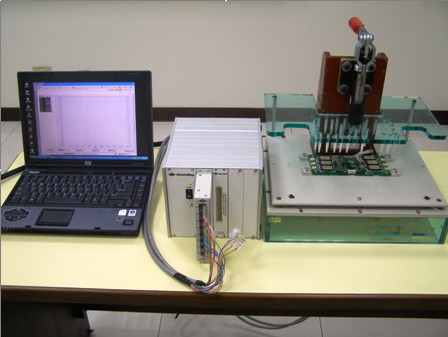
To help address PCB strain gage measurement, we at Chief-SI developed a turnkey solution called StrainMap using NI LabVIEW software and NI modular hardware such as SCXI and NI CompactDAQ. The StrainMap, a suitable solution for most strain measurements, is most commonly used for measuring the strain on PCB motherboards and the strain and acceleration for mobile phone drop tests.
Abstract
To make a strain measurement, the first step is to choose a suitable strain gage based on the testing purpose and environment. Strain gage installation also has specific steps and procedures.
At least 12 strain measurement channels are required for strain testing on motherboard PCBs, and today’s common applications require at least 24 synchronized channels with three additional sets of acceleration channels for mobile phone drop testing. Also, according to the new testing procedure, each channel’s sampling rate must be more than 20 kS/s, which is difficult to achieve. We overcame this challenge using the NI SCXI-1520 universal bridge input module and NI SCXI-1000 4-slot chassis.
When considering data, users are most interested in the maximum strain value over the period of the test rather than individual strain values. Software based on LabVIEW in the StrainMap solution provides a user-friendly graphical user interface (GUI), configuration wizards, Mohr’s circle analysis, and strain-rate calculation.
Strain measurement equipment generally includes the following:
- Sensor: strain gage
- Connectivity: signal terminal
- Signal conditioning: module with bridge completion, excitation, and filtering
- Chassis
- Analog-to-digital conversion: 16-bit data acquisition device
Description
Our Chief-SI StrainMap integrates SCXI hardware and the theory of mechanics to calculate and present data in a user-friendly GUI, including complete functions and simple operations.
Our solution has the following advantages:
- High-precision and synchronized multichannel measuring equipment
- Resolution: ±3 υε at 2 k sampling rate
- Synchronized-sampling rate: StrainMap 2 kS/s and StrainMap Enhanced 50 kS/s
- Channels: 128-channel maximum
- Simple hardware interface and friendly GUI for all required configuration
- Patented signal terminals, plug-and-play style
- GUI to configure the setting
- IPC-9704 guideline support for PCB strain gage testing and other related techniques
- Real-time, multichannel signal curve display and continuous data recording
- Strain signal curve of each channel displayed in real time
- Mohr’s circle function provided to show information about the maximum strain value and aspect
- Enhanced gauging efficiency and complete functionality for report generation
- Supports major strain gauging report formats
- States maximum and minimum strain values for each channel
- Supports strain rate calculation
- Directly offers strain measurement exporting to Microsoft Excel
- Dynamic strain measurement support (StrainMap Enhanced only)
- Accommodates a sampling rate up to 50 kS/s for faster acquisition rates used in drop test
- Gauges the strain behavior and the acceleration signals at the same time, which is in coherence with drop test standards
Conclution
StrainMap solution was adopted by Intel, HP, Lenovo, Foxconn, ASUS, Compal Electronics, Inventec, and other companies in the PCB motherboard and mobile phone-related industries.